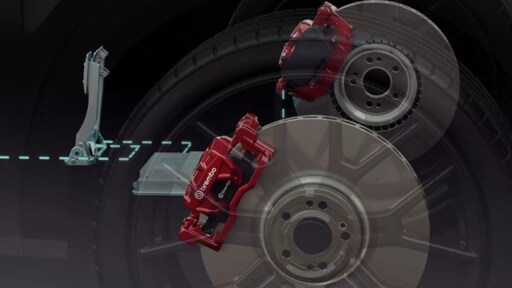
Love how people in this post believe THE brake manufacturing company, single supplier for virtually all competition-level vehicles, not to mention billions of road vehicles, are a bunch of dumbasses who can’t design a different version of their MAIN PRODUCT.
I don’t have an issue with a new system per se. This gives me pause though.
The announcement was light on details about both the system itself and how its fail-safes are implemented
The system they propose is a brake by wire system that uses electric motors. What happens when you have no power? On an EV this might be moot. What happens after an accident and this system is damaged? I’ve seen plenty of cars start to roll after an accident until the driver applies the brakes. Tesla and their door handles not working is an example of critical systems not working after accidents. I’m mostly curious about what failsafes are in place in this new system. Seems premature for name calling without all the information.
For this system to catch on it needs to either be better than the current systems by a large enough margin, cheaper, or more reliable(aka less warranty claims).
We already have electronic parking brakes on cars. Motor spins the piston in and it has far more clamping force than a drum on hat or lever style caliper or conventional drum. Problem is I live in New England and regularly see them come in with errors because the wires rotted off, while the hydrolics brake lines are still in tact. What’s funny about that is I work in a 4x4 shop where we set up a lot of ram steer systems (hydrolics ram used to steer the wheels) and unless it’s a buggy we set them up in conjunction with ur standard steering linkage (all mechanical links to the knuckles) because not having linkage is considered a safety hazard on the road and illegal. However, it’s totally fine that the cyber truck rear wheels are steered purely via electronics 🙄 I would NEVER trust a pair of 16 gauge wires to tell my brakes to make me stop. I’ve blown the rear brake line in my 40 year old jeep and I just vice grips the rear line shut and drove home with the front brakes only. If a wire rots off at the connector as they always do you need to replace the connector, and odds of u having spares handy and de-pinning tools and extra wire and heat shrink and crimpers etc on board are a lot lower than having a set of leathermans or vice grips or using a rock on the side of the road to ash the line and pinch it shut it before the break.
Right now there’s also not any failsafes for the break lines failing
Yes there are.
First of all, all cars that you’re actually going to drive on the road have two hydraulic brake systems that are almost entirely in parallel. Go look at the master cylinder in your car, there are two lines coming out of the side of it. The way that works is a floating piston; the brake pedal pushes on a piston that applies hydraulic pressure to the first line, and to a piston that floats in the master cylinder which applies pressure to the second line. If either hydraulic system were to fail, that floating piston will bottom out on that side and allow pressure to still be applied to the remaining hydraulic circuit.
If the rear one fails, the floating piston will physically touch the piston attached to the pedal, and be pushed directly. If the forward one fails, it’ll bottom out against the free end of the master cylinder and allow the other to continue working.
Most systems connect one front wheel and one back wheel to each circuit, often in opposite corners of the vehicle. You can lose one line and still have at least partial braking force.
Umm have you heard of honking?
I’ll remember that if my brakes ever completely fail at speed and I’m about to Tbone a wall
Yeah, tell that wall to get out of your way.
https://en.wikipedia.org/wiki/Lighthouse_and_naval_vessel_urban_legend#Example
Aaah yeah cheers, thanks for the blast from the past hahaha
That slows down your car?
My car has a valve where you might lose some wheels but not all with a line failure. It’s better than nothing. The parking/emergency brake is a manual cable. Don’t know how that is implemented in this new system either.
Most vehicles have some form of dual braking system as a fail safe. Random internet image…

But this is the same as just having a split electrical circuit to a brake-by-wire solution. It’s only a pseudo-redundant system because you still rely on a single type of mechanical connection to brakes.
Kind of but if the electricity goes out it doesn’t matter how many circuits you have. They all don’t work. You could say the same about the brake fluid but I can’t flip a switch in the cab to drain the brake fluid but I can leave a light on to drain the battery. That’s why I’m curious what the fail safes are. They could have multiple power sources. We don’t know…
I was simply responding to your comment that there weren’t any fail safes to losing a brake line and there are. Losing a single line or two lines in the same circuit doesn’t cause a catastrophic failure and you can stop the vehicle albeit with reduced braking performance.
Easiest way to design it would probably be by making it a NC circuit so they brake unless they have power to open the brake cylinders.
I drive solely using one pedal on my Bolt, and brake only when I need to stop faster. As long as it’s reliable and safe this should be fine. Regenerative braking is really fun.
and brake only when I need to stop faster
So you don’t drive solely using one pedal then? Sometimes you use the brakes?
To add, I truly never take my car off of one pedal mode, and solely keep it in one pedal mode.
Well that sounds terrifying. There’s a reason why the brake hydraulicsystem is actually two separate hydraulic systems, for diagonally opposite wheels. The only single-point-of-failure is the brake pedal.
Their leaving out the critical details on how this will electric system will be fail safe, or even legal.
The announcement was light on details about both the system itself and how its fail-safes are implemented.
Maybe they’ll return to spring actuated mechanical brakes that are released when everything is working. (More common in heavy industry, and I believe also truck brakes)
The only single-point-of-failure is the brake pedal.
And even then, only on cars with those stupid electronic parking brakes instead of a proper mechanical emergency brake.
Preach! Looking at you, Nissan. Need a computer to change brake pads. Are you outta your goddamn mind?
Takes 30 seconds to learn how to jump the switch with 3 cents of wire. If you don’t understand that, you should not be working on brakes.
I’m with automakers on this. Countless morons switch brake pads DIY until they burn through the brake rotors. As long as North America refuses to safety inspect vehicles, this lockout saves lives.
As long as North America refuses to safety inspect vehicles
Wait WHAT?
The European brain can not comprehend.
The European brain can not comprehend.
…that north America is a big continent with multiple countries and dozens of states, and many of these states do indeed require safety inspections.
You’re not alone. I’ve seen plenty of Europeans having trouble comprehending that.
So you confirm that there are states where vehicles don’t get inspected. Thanks. I wasn’t sure it could be true.
I can further confirm this is the case on the Isle of Man, Jersey, Gurnsey, and Gibralter, all of which are in Europe.
So by your logic, I can say, accurately, ‘europeans don’t require automobile safety inspections’.
The North American brain cannot comprehend.
Pulling the handbrake on a moving vehicle is generally speaking really bad idea. It’ll stop, yeah, but it’ll be really scary for a moment before that.
Scary? Maybe if it’s your first time doing it. It engages specific brakes in a specific way. Pull it slowly to see how it works.
Go pull a handbrake on a highway speed simulating an emergency situation and then report back. I’ll wait.
moving the goalposts already are we?
There are only two reasons to pull the emergency brake in a moving vehicle: either you’re messing around and making the car fishtail was the desired outcome, or your regular brakes failed and you need to stop fast instead of just coasting to a halt. In the latter case, the vast majority of people will lose control of the car immediately and it will be absolutely terrifying experience.
…what about handbrake turns?
how dare someone drive in a manner you disapprove of and then not get in an accident.
Come with me on an ADHD journey!
Spring actuated, or well, any type of ‘fail closed’ brake design would definitely work.
But what happens if it fails closed (due to no power - the only failure mode I’ve considered below) and the vehicle needs to be moved?
Are they gonna do that thing they do with elevator emergency brakes with the spinning balls that engage the brakes only if a certain inertial threshold is reached? That way as long as they aren’t going too fast, the car can be pushed off the road?
Or are they gonna let you plug in a phone to charge the brake system enough to disengage the failsafe?
Maybe there will be a sweet-ass lever under the center console like the one in the first Jurassic Park movie where people have to pump it to prime the system?
My favorite iteration of this nonsensical idea is that new cars are going to come with a crank in the front, like old-school model T’s, so that in an emergency, people can wind up their cars to release the brakes.(Please consider all of the above as me having too much time on my hands, and not a real critique of your statements. I think failsafes are a good idea. I’m just a silly.)
But what happens if it fails closed (due to no power - the only failure mode I’ve considered below) and the vehicle needs to be moved?
the same as all other cars with locked axles, they tow on a wheel sub trailer.
In fact, according to BMW, drivers of current EVs pretty much never activate their mechanical braking systems, relying instead on their electric motors to handle the job.
I didn’t think the regen could bring a car to a complete stop, like at a stop sign or a red light. They’re certainly not using the motors to hold your place on a hill, are they?
Or are they just saying BMW drivers never stop when they’re supposed to?
In Formula E, they mostly brake with regen so much so that they completely did away with rear brakes. Whether or not current road cars can do the same I do not know. But from what I have heard many electric cars have problems with their brakes because they are used soo infrequently.
They did away with rear hydraulics…for awhile. After testing incidents they added back in a one time use hydraulic emergency system for the rear.
Very interesting
I didn’t think the regen could bring a car to a complete stop
Yes, it can. Newer axial motors can actually put -700hp of stopping power per wheel, and the whole motor hub assembly weighs less than a brake assembly. All that energy was previously wasted as heat by braking.
700hp of stopping power per wheel isn’t regen braking, that’s dumping battery power into a stopping force.
What do you think the (-) means? No, braking like this does not use battery power. Read the link. YASA is a Cambridge scientist with a string of papers on axial hub motors, they have a massive resistive force.
This isn’t SAE dipshits from Detroit.
This is a terrible idea.
Braking systems need MORE redundancy. Not less.
Electronics are mostly solid state and are therefore virtually wear-free.
If it’s designed well, they could actually be more reliable than pushing fluids through tubes. But pushing fluids through tubes is already pretty fucking reliable.
I think the main point is to eliminate rusting brake discs from EVs, which rely largely on regenerative braking anyway. I know mine are constantly crusty; like I can always hear them scraping for the first few hundred meters of driving. Which is prolly not great.
That’s going to be very interesting to see failure rates and modes on the road over time.
We at least know it could potentially have really low failure rates since airplanes have the same type of systems today, and that’s highly regulated
I’m more concerned about the failure mode than the failure rates. Mechanical and hydraulic brakes can experience gradual failure, giving the driver a chance to pull over get the car repaired.
EVs usually have a single motor and a single inverter , both of which can fail suddenly. Electronics usually work perfectly fine until they suddenly don’t work at all (blown fuse, bad connection, blown capacitor etc)
How are they gonna build redundancy so that no single component failure means youre freewheeling downhill on the highway
Back in the day you had to have two distinct hydraulic lines, crossing over and serving 3 wheels each, so that you could still break if one went down, but you’d feel it.
Guess they’ll have at least 2.
single component failure means youre freewheeling downhill on the highway
Do people really think Professional Engineers are stupid?
Yeah, they’d never put an unsafe vehicle into production. It would help boost confidence if someone explained what the backup plan is.
I had more faith before Tesla
No, but their bosses might be.
Ain’t that the truth
Brakes on airplanes are used infrequently (though when they’re used, they’re safety-critical) so the usage pattern is very different than for cars.
And inspected after every use.
That’s the real difference to me, maintenance. Planes have a strict schedule of inspection and replacement. Moms minivan last saw an oil change before the kids made it to middle school. There’s going to be some failures.
Is that true? I thought most purpurnen kept up with oil changes
Brembo’s new “Sensify” braking system takes that one step further, eliminating the hydraulic system entirely and relying instead purely on electronic brake-by-wire and electric motors
OK now show us a scenario where the vehicle is badly damaged in a traffic collision, the electrical system is compromised, (possibly even on fire) and show me the vehicle slowing to a stop safely with no electrical systems functioning what-so-ever or GET OUT OF HERE WITH THIS INSANITY
I have had hydraulic brakes fail more than while driving. They can fail even when the lines are fully intact.
GET OUT OF HERE WITH THIS INSANITY
I have driven home more than once using the cable brake backup after a hydraulic failure.
I also have owned vehicles where the heat-based pads and rotors system overheated and severely lost braking ability after a single stop from 70mph.
Luckily I discovered that using the cable brake on the cars I drove made them uncontrollable before I got into an emergency. I ruled that out once I did a full 360 at 5 mph on a regular road,
I learned to emergency stop on the transmission. Slow down on the gears and eventually fuck it up dropping it into park
So, yeah, pulling the e-brake hard on the highway can be… exciting, which is generally not what you want in an emergency situation.
This was more of a case of: welp, I’m 10 miles from home and I have a choice: pull over and arrange for a tow truck, or proceed with all due caution on the safest possible routes and get it home without wasting many hours of my time and hundreds of my dollars on the tow.
Now, when the fuel line got chewed by squirrels and a gasoline spray-fountain was emerging from the wheel well… yeah, towtruck time. But bad brakes? Depends on the situation, many situations can be safely handled with the “performance level” you get from cable brakes on the rear wheels.
Oh, one tip should you ever try using the parking brake to stop while rolling: make sure you know how to release it and keep the ability to release it engaged whenever applying the brakes while moving. If you let it latch up, you’re gonna be a passenger not a driver.