Well that sounds terrifying. There’s a reason why the brake hydraulicsystem is actually two separate hydraulic systems, for diagonally opposite wheels. The only single-point-of-failure is the brake pedal.
Their leaving out the critical details on how this will electric system will be fail safe, or even legal.
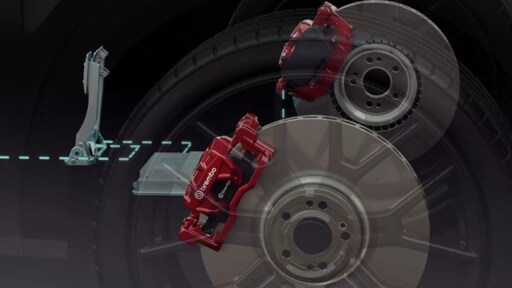
The announcement was light on details about both the system itself and how its fail-safes are implemented.
Maybe they’ll return to spring actuated mechanical brakes that are released when everything is working. (More common in heavy industry, and I believe also truck brakes)
Spring actuated, or well, any type of ‘fail closed’ brake design would definitely work.
But what happens if it fails closed (due to no power - the only failure mode I’ve considered below) and the vehicle needs to be moved?
Are they gonna do that thing they do with elevator emergency brakes with the spinning balls that engage the brakes only if a certain inertial threshold is reached? That way as long as they aren’t going too fast, the car can be pushed off the road?
Or are they gonna let you plug in a phone to charge the brake system enough to disengage the failsafe?
Maybe there will be a sweet-ass lever under the center console like the one in the first Jurassic Park movie where people have to pump it to prime the system?
My favorite iteration of this nonsensical idea is that new cars are going to come with a crank in the front, like old-school model T’s, so that in an emergency, people can wind up their cars to release the brakes.
(Please consider all of the above as me having too much time on my hands, and not a real critique of your statements. I think failsafes are a good idea. I’m just a silly.)
There are only two reasons to pull the emergency brake in a moving vehicle: either you’re messing around and making the car fishtail was the desired outcome, or your regular brakes failed and you need to stop fast instead of just coasting to a halt. In the latter case, the vast majority of people will lose control of the car immediately and it will be absolutely terrifying experience.
Takes 30 seconds to learn how to jump the switch with 3 cents of wire. If you don’t understand that, you should not be working on brakes.
I’m with automakers on this. Countless morons switch brake pads DIY until they burn through the brake rotors. As long as North America refuses to safety inspect vehicles, this lockout saves lives.


Well that sounds terrifying. There’s a reason why the brake hydraulicsystem is actually two separate hydraulic systems, for diagonally opposite wheels. The only single-point-of-failure is the brake pedal.
Their leaving out the critical details on how this will electric system will be fail safe, or even legal.
Maybe they’ll return to spring actuated mechanical brakes that are released when everything is working. (More common in heavy industry, and I believe also truck brakes)
Come with me on an ADHD journey!
Spring actuated, or well, any type of ‘fail closed’ brake design would definitely work.
But what happens if it fails closed (due to no power - the only failure mode I’ve considered below) and the vehicle needs to be moved?
Are they gonna do that thing they do with elevator emergency brakes with the spinning balls that engage the brakes only if a certain inertial threshold is reached? That way as long as they aren’t going too fast, the car can be pushed off the road?
Or are they gonna let you plug in a phone to charge the brake system enough to disengage the failsafe?
Maybe there will be a sweet-ass lever under the center console like the one in the first Jurassic Park movie where people have to pump it to prime the system?
My favorite iteration of this nonsensical idea is that new cars are going to come with a crank in the front, like old-school model T’s, so that in an emergency, people can wind up their cars to release the brakes.
(Please consider all of the above as me having too much time on my hands, and not a real critique of your statements. I think failsafes are a good idea. I’m just a silly.)
the same as all other cars with locked axles, they tow on a wheel sub trailer.
And even then, only on cars with those stupid electronic parking brakes instead of a proper mechanical emergency brake.
Pulling the handbrake on a moving vehicle is generally speaking really bad idea. It’ll stop, yeah, but it’ll be really scary for a moment before that.
Scary? Maybe if it’s your first time doing it. It engages specific brakes in a specific way. Pull it slowly to see how it works.
Go pull a handbrake on a highway speed simulating an emergency situation and then report back. I’ll wait.
moving the goalposts already are we?
There are only two reasons to pull the emergency brake in a moving vehicle: either you’re messing around and making the car fishtail was the desired outcome, or your regular brakes failed and you need to stop fast instead of just coasting to a halt. In the latter case, the vast majority of people will lose control of the car immediately and it will be absolutely terrifying experience.
…what about handbrake turns?
That’s the messing around part.
how dare someone drive in a manner you disapprove of and then not get in an accident.
I genuinely have no clue what you’re even disagreeing with.
Preach! Looking at you, Nissan. Need a computer to change brake pads. Are you outta your goddamn mind?
Takes 30 seconds to learn how to jump the switch with 3 cents of wire. If you don’t understand that, you should not be working on brakes.
I’m with automakers on this. Countless morons switch brake pads DIY until they burn through the brake rotors. As long as North America refuses to safety inspect vehicles, this lockout saves lives.
Wait WHAT?
The European brain can not comprehend.
…that north America is a big continent with multiple countries and dozens of states, and many of these states do indeed require safety inspections.
You’re not alone. I’ve seen plenty of Europeans having trouble comprehending that.
So you confirm that there are states where vehicles don’t get inspected. Thanks. I wasn’t sure it could be true.
I can further confirm this is the case on the Isle of Man, Jersey, Gurnsey, and Gibralter, all of which are in Europe.
So by your logic, I can say, accurately, ‘europeans don’t require automobile safety inspections’.
The North American brain cannot comprehend.
The straw men tremble in their boots.