You must log in or # to comment.
This is old technology that is more expensive/complicated/maintenance-ey than PV. An economic falacy is that if you have oil/fossils you should use that instead of solar. It’s always better to use cheapest energy. Export the fossils, import solar. It is more jobs to have solar as well, and in fact most of the deployment costs are local work/materials (wiring/support structures).
now hear me out. what if we just boiled water in it. why do we have to get all fucky with it.
The ultimate bird bath
ah yes the bird blaster
I know this is a meme community but I was curious about this. It seems some birds do get burned, but not blasted. It varies a lot depending on the installation and it can also be mitigated. Also, the amount of birds dying from this is significantly lower than just the amount of birds hitting windows. For the benefit of other curious people, I’ll try to condense the relevant information from wikipedia and the sources.
In more general terms, a 2016 preliminary study assessed that the annual bird mortality per MW of installed power was similar between U.S. concentrated solar power plants and wind power plants, and higher for fossil fuel power plants.

How it was calculated for fossil fuel
Sovacool estimated avian mortality from fossil fuel power plants across the United States as a result of collision with infrastructure, electrocutions, pollution and contamination, and climate change. In addition, Sovacool estimated climate change-induced avian mortality (in terms of habitat loss and changes in migration) predicted to be the result of fossil fuel power plant operations.
A preliminary assessment of avian mortality at utility-scale solar energy facilities in the United States: https://www.sciencedirect.com/science/article/pii/S0960148116301422?via=ihub
Review of Avian Mortality Studies at Concentrating Solar Power Plants: https://www.osti.gov/servlets/purl/1364837
They can’t keep getting away with this!!
wait these could be built with co2 turbines as well, right??
Yes, super critical CO2 turbines can work in such a system. As can sterling engines. Or thermoelectric solid state couples.
Any system that uses a temperature differential to generate power can be used. It’s just a matter of what you care about in a given situation. Upfront cost, mechanical reliability, noise/vibration, and availability of needed components play in to what makes the most sense.

Everybody with a college course in Thermodynamics.
It turns out spinning things is really useful and boiling fluids is a convenient way to spin things.
“I’ll try spinning! That’s a good trick!”
Wisdom from a Jedi born to bring balance to things.
But not to be a master.
As an old Jedi Master once said, “[Masters] are what they grow beyond”
But spinning is so much cooler than not spinning!
It’s still funny that so much boils down to steampunk with a fake mustache.
boils down to
I see what you did there!
Wait, it’s all steampunk?
Always had been.
Not enough brass, though
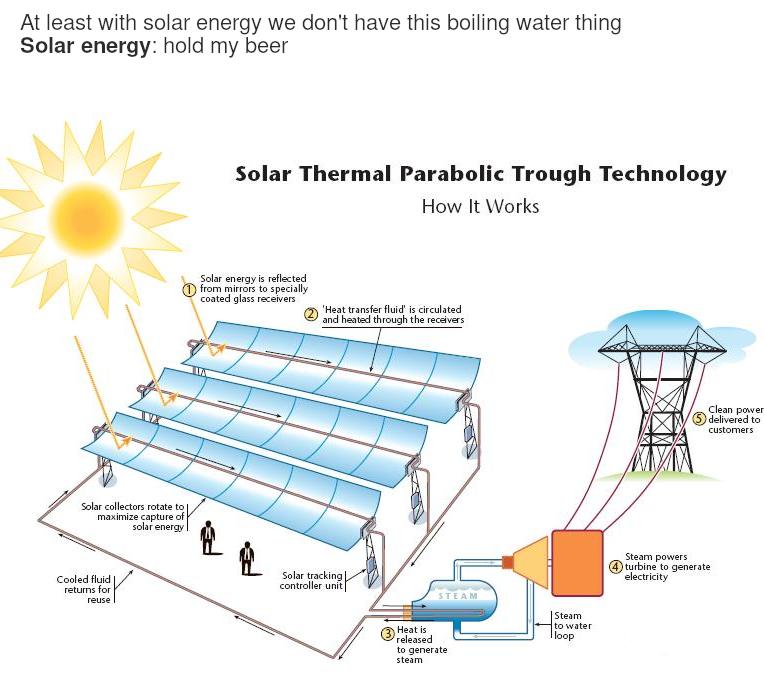
It’s called CSP https://en.wikipedia.org/wiki/Concentrated_solar_power
Would solar boilers be more efficient than PV?
No, neither will it be cheaper.
People stopped building those some years ago.
(But those incredibly expensive concentrators with a single tower are more efficient. Nobody is building those anymore either.)
I assume not efficient enough to justify cost
Turns out that sunlight is very cheap. You need a lot of efficiency to justify any extra cost.
Plus, you get a lot of lag when heating water with concentrated solar. Overnight your water cools down, so you need time to get it back to boiling temperature before it can generate any power. That lag gets worse during winter and cloudy days
In some ways, that lag is good. You can cheaply replace batteries with just a thermal mass.
But it’s not good enough to make up for the cost difference.
The sunlight spent just to get the water up to temperature is also wasted, so the maximum extractable energy per day gets kneecapped
PV panels have very low maintenance needs
They used to be cheaper. Solar is bananas cheap now
Generating electricity by boiling water used to be the cheapest option, but nowadays it’s a bottleneck that itself is way more expensive than the alternatives that people actually build.
It only got cheaper with time, though. It’s the alternatives (PV, wind, batteries, gas) that improved a crazy amount.
Another thread I read said that photovoltaics have an efficiency of around 45%, while turbines are somewhere in the 40% range. Source: I dunno.
PVs max out around 28%
Turbines are over 90% efficient.
Traditional Rankine cycles with a boiler, a turbine and a condenser have efficiencies lower than 40%, I’ve never seen one higher than 30%.
Punches below the belt. Right in the photovoltaics.
I wonder if we could kill 2 birds with one stone. Have parabolic solar panels that reflect unabsorbed light to boil water.
You’d just have 2 inefficient power generators
It would be a less efficient boiler (because the ‘mirrors’ would be much less reflective), and much more expensive (because solar panels – especially custom-made curved ones – are much more expensive than mirrors).
Overall, I suppose maybe you could come out ahead if you used very efficient solar panels for it, and that would let you generate slightly more watts per surface area used…
But we really don’t need to optimize for surface area in 99% of cases. Almost everywhere solar power is used, space to install panels is abundant, and it would be much cheaper and more effective to just put one or the other of these solar collection methods over a slightly wider area if you want increased production. (And even then, most of the cases where production-per-surface-area is very important are on solar-powered vehicles, and these parabolic sun-tracking mirrors are impractical for use on a moving vehicle.)
How about running water through the back side of the panels to keep them cool, transfer the heat into a heat battery (sand) then us that to assist your hot water heater.
Either that or use it for temperature differential power generation.
Although I guess you could use the power generated by the panels to run a heat pump to boil the water used for cooling too.
It all boils down to steam…
With all the solar mirrors, won’t we overhear the sun shooting all that light back?
there’s a silencer on its gun, so we probably won’t hear much.
At least hydro and wind power are still safe from the boiling water…
Still safe so far
Hydro is the OG boiled water.
Sun heats water. Water evaporates. Go up high. Falls down. Turn turbine.
Wind power is a side effect of the same process happening on a rotating globe.
Solar thermal is kinda obsolete I thought, now China is churning out PVs for pennies.
Solar thermal has some distinct advantages when you start talking about really big instillations. Especially when considering power storage, molten salt systems can store heat and allow the generators to keep working even at night. Much cheaper than batteries at very large scales.
Thermal solar systems are generally very efficient when the goal is heating something, not just generating power. So say, you want to run an ammonia plant without burning natural gas, or if you want to melt down metals for recycling. There are so many industrial applications where it’s a better way of doing it than using an electric heating element.
I mean it seems the more complex solution in deployment for sure, but its design could still have use in low heat industrial uses (sub 250°C, e.g. food prep, textile, sanitation etc.) where it is used heat -> heat rather than heat -> electricity -> heat. Maybe these replace thermal collectors eventually.
But that is not the point of this meme at all, just my thoughts.
IDK, heat pumps are basically multiplying the electricity they use.
Only with small temperature differences, the higher the difference the lower the COP.
You need a giant asterisk there. That “small temperature difference” is -40° to 120°F
I really don’t get where those temperatures come from? I was referring to something like this. The higher the temperature difference between cold and warm side, to worse the COP gets. If you wanted to go from ambient to 200°C, the COP would drop lower than 1 and you’d be better off using an electric boiler.
My point is that the “small difference in temperatures” where it’s worthwhile to run a heat pump is still wide enough to run an air-exchange heat pump cost effectively damn near anywhere on Earth outside of the poles. You’re arguing the finges when almost nobody would be affected by it.
And if you’re using a geothermal heat pump, your thermal sink continuously sits around 50°F (while homes tend to be kept at 65-75°F), which means it should always be efficient.
Quit this conservative-esque route of arguing. It’s bullshit and you know it.
You need to quit the bullshit yourself and learn to read. We were specifically discussing heat pumps for industrial heat use in the sub 250 degrees Celsius range, not keeping a house at a comfortable temperature. But good luck heating a home in the desert with a heat pump with the evaporator on a solar boiler.
For heating I’d guess it can still be relevant. As a means of producing electricity though? Yeah
But t solar boiler can still be useful in some cases. Where heated water in “solar” on the roof is used immediately for shower etc.
Modern solar into a modern heat pump is gonna be more efficient than heating water. It’s also more versatile and convenient, cause it maintains that efficiency when you pull power from the grid at night. And of course lets you use the power for other purposes.
I agree. But installing a waterboiler on a roof right above a shower is a lot simpler and probably still cheaper, for example in a camping hut situation, so off grid
Lots of huts probably have an ac or heater. This could all be the same device, at which point it’d definitely be easier than running the pipes for water and maintaining pumps and a dedicated tank.
Don’t see a reason you couldn’t have a simple ac window unit that also has a warm water port, which you plug a single cable into going straight to your pannels on the roof.Edit: And once batteries are more affordable (or if you have a few grand to burn) you can then plug in a battery pack conveniently on the indoors side of your window unit.
The indoors side can just have a few regular outlets you can extension cord around to where you need them.
I really like the concentrated solar systems that use molten salt, where rather than heating water directly, molten salt is heated and stored In large insulated tanks and tapped off to a heat exchanger to run the turbines, thus allowing power generation to match demand and continue at a constant rate even when light level very (such as at night).
One interesting idea is to use a concentrated solar system to run an Einstein–Szilard refrigerator, or some other absorption refrigerator cycle.
What are the tanks made of? “Molten salt” sounds like it would fuck up most materials
Nokia 3310s.
If you’re gonna build it, you might as well over-build it I guess…
As a first guess, I would use glass fused to steel tanks. I would need to do a detailed look at material compatibility, talk to vendors, and run some bench scale studies before I moved forward with anything.
Source: am licensed engineer
Various common steels with a bunch of insulation around it usually, sometimes with a thin coating. The potassium/sodium/calcium nitrate mixes that are used with concentrated solar systems operating in range between 200 C and 600 C. So like, yah you don’t want to touch it, but it’s not gonna do much to steel. It can be somewhat corrosive, but, this is fairly easily mitigated by design.
Molten salt for heat transfer and thermal storage is a pretty mature technology that goes way back before we started using it in concentrated solar systems.
Molten salt for heat transfer and thermal storage is a pretty mature technology that goes way back before we started using it in concentrated solar systems.
Isn’t the core problem with anything that uses molten salt is that when the heat
saucesource (thanks autocorrect, really, the context in that sentence means you should suggest “sauce”?) fails you just end up with a huge lump of solid salts that clog every part of your system?The Russian Alfa class had a similar problem due their use of lead-bismuth heated into a liquid.
When they lost power for whatever they’d essentially end up being written off as reheating them was incredibly difficult and very tricky.