As a first guess, I would use glass fused to steel tanks. I would need to do a detailed look at material compatibility, talk to vendors, and run some bench scale studies before I moved forward with anything.
Various common steels with a bunch of insulation around it usually, sometimes with a thin coating. The potassium/sodium/calcium nitrate mixes that are used with concentrated solar systems operating in range between 200 C and 600 C. So like, yah you don’t want to touch it, but it’s not gonna do much to steel. It can be somewhat corrosive, but, this is fairly easily mitigated by design.
Molten salt for heat transfer and thermal storage is a pretty mature technology that goes way back before we started using it in concentrated solar systems.
Molten salt for heat transfer and thermal storage is a pretty mature technology that goes way back before we started using it in concentrated solar systems.
Isn’t the core problem with anything that uses molten salt is that when the heat sauce source (thanks autocorrect, really, the context in that sentence means you should suggest “sauce”?) fails you just end up with a huge lump of solid salts that clog every part of your system?
The Russian Alfa class had a similar problem due their use of lead-bismuth heated into a liquid.
When they lost power for whatever they’d essentially end up being written off as reheating them was incredibly difficult and very tricky.


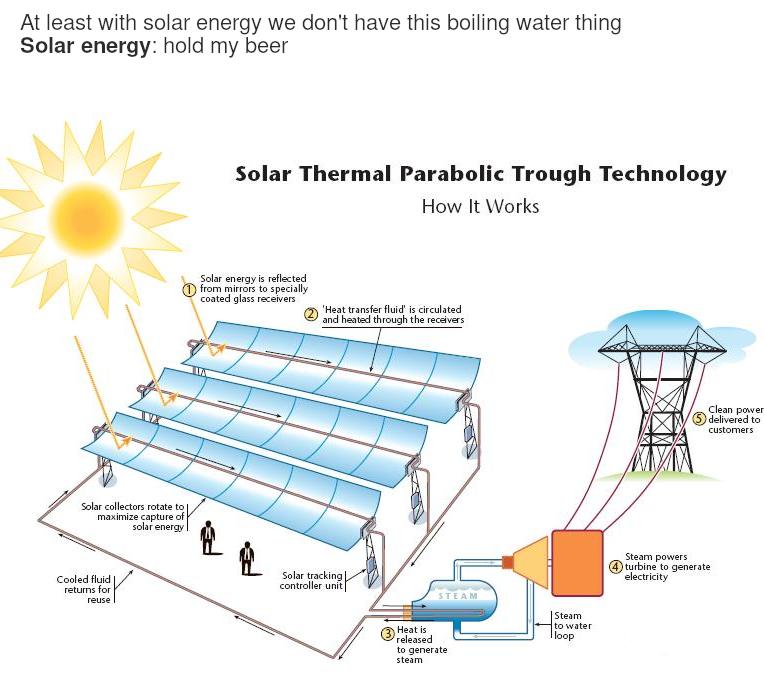
What are the tanks made of? “Molten salt” sounds like it would fuck up most materials
As a first guess, I would use glass fused to steel tanks. I would need to do a detailed look at material compatibility, talk to vendors, and run some bench scale studies before I moved forward with anything.
Source: am licensed engineer
Various common steels with a bunch of insulation around it usually, sometimes with a thin coating. The potassium/sodium/calcium nitrate mixes that are used with concentrated solar systems operating in range between 200 C and 600 C. So like, yah you don’t want to touch it, but it’s not gonna do much to steel. It can be somewhat corrosive, but, this is fairly easily mitigated by design.
Molten salt for heat transfer and thermal storage is a pretty mature technology that goes way back before we started using it in concentrated solar systems.
Isn’t the core problem with anything that uses molten salt is that when the heat
saucesource (thanks autocorrect, really, the context in that sentence means you should suggest “sauce”?) fails you just end up with a huge lump of solid salts that clog every part of your system?The Russian Alfa class had a similar problem due their use of lead-bismuth heated into a liquid.
When they lost power for whatever they’d essentially end up being written off as reheating them was incredibly difficult and very tricky.
Nokia 3310s.
If you’re gonna build it, you might as well over-build it I guess…