That framing is missing a lot. Open source software is way more than about using the code. For me, it is not the bugs and quality that concern me most about things like this (though I do have concerns with that too). It’s about the broader issues with LLMs in terms of cooperate power, environmental impact, etc. Calling it out is less about any one project and more about stopping the whole open source ecosystem from spiraling into an LLM-dependent mess. LLMs themselves can easily become the death of FOSS in a broader sense
LLMs flip the power dynamics of development on their head. For starters, the outputs are likely no longer copyrightable in many jurisdictions, which undermines copyleft licenses (rsync is under GPL for example).
The kind of code that LLMs generate also tend to add complexity rather fast where it becomes more and more difficult for any human to understand it. Becoming dependent on LLMs makes development more of a question of computing power rather than effort. Companies will be able to spend more than you. FOSS will not be able to compete nearly as well. It’s also an inherent dependency on big tech companies who will be happy to exploit that the second they can or cut you off it you start to hit their bottom line. Software cannot be free in terms of freedom if modifying it in a reasonable amount of time starts to almost require a tool controlled by someone else
Using “Open Source” (which has somehow become “public weights” to most) / local LLMs are hardly freedom from this either given that they will always be behind given the massive financial costs to make models, unlike traditional software. If you find any advantage or way to reduce resource usage to make a better model, the bigger tech companies will just quickly scale that up far bigger than you can and meet or exceed what you have. It still just as well makes your ability to modify software dependent on the hardware you have. How free is open source software if it becomes increasingly difficult to modify without an expensive GPU?
I have worked on open source projects. I cannot fork sheer number of projects going towards LLMs alone. This is a losing proposition. Open source is not an individualistic action. This is a collective action, and we need developers of open source to live the values of open source
someone else can pick up from here
A big point of my comment earlier was that making a project increasingly LLM generated makes it harder for someone to pick up as quickly. A huge amount of complexity can be added insanely fast. In this rsync example, the entire testing system was changed overnight (while generating issues in the process). The projects become harder to work on in general
EDIT: also to add, this still has the issues of not knowing where the un-copyleftable code lies and/or having to rework large portions of the project are if you want to keep that


That framing is missing a lot. Open source software is way more than about using the code. For me, it is not the bugs and quality that concern me most about things like this (though I do have concerns with that too). It’s about the broader issues with LLMs in terms of cooperate power, environmental impact, etc. Calling it out is less about any one project and more about stopping the whole open source ecosystem from spiraling into an LLM-dependent mess. LLMs themselves can easily become the death of FOSS in a broader sense
LLMs flip the power dynamics of development on their head. For starters, the outputs are likely no longer copyrightable in many jurisdictions, which undermines copyleft licenses (rsync is under GPL for example).
The kind of code that LLMs generate also tend to add complexity rather fast where it becomes more and more difficult for any human to understand it. Becoming dependent on LLMs makes development more of a question of computing power rather than effort. Companies will be able to spend more than you. FOSS will not be able to compete nearly as well. It’s also an inherent dependency on big tech companies who will be happy to exploit that the second they can or cut you off it you start to hit their bottom line. Software cannot be free in terms of freedom if modifying it in a reasonable amount of time starts to almost require a tool controlled by someone else
Using “Open Source” (which has somehow become “public weights” to most) / local LLMs are hardly freedom from this either given that they will always be behind given the massive financial costs to make models, unlike traditional software. If you find any advantage or way to reduce resource usage to make a better model, the bigger tech companies will just quickly scale that up far bigger than you can and meet or exceed what you have. It still just as well makes your ability to modify software dependent on the hardware you have. How free is open source software if it becomes increasingly difficult to modify without an expensive GPU?
I recommend demonstrating your values with helpful actions like donating to FOSS projects, forking them, etc
The lack of control and sustainability you’re articulating represents one side of the basic nature of FOSS.
There are no shareholders.
The other side of it is that it’s open source - someone else can pick up from here and do it their way and there’s nothing stopping them or you.
There’s no good reason to go after the developer.
deleted by creator
I have worked on open source projects. I cannot fork sheer number of projects going towards LLMs alone. This is a losing proposition. Open source is not an individualistic action. This is a collective action, and we need developers of open source to live the values of open source
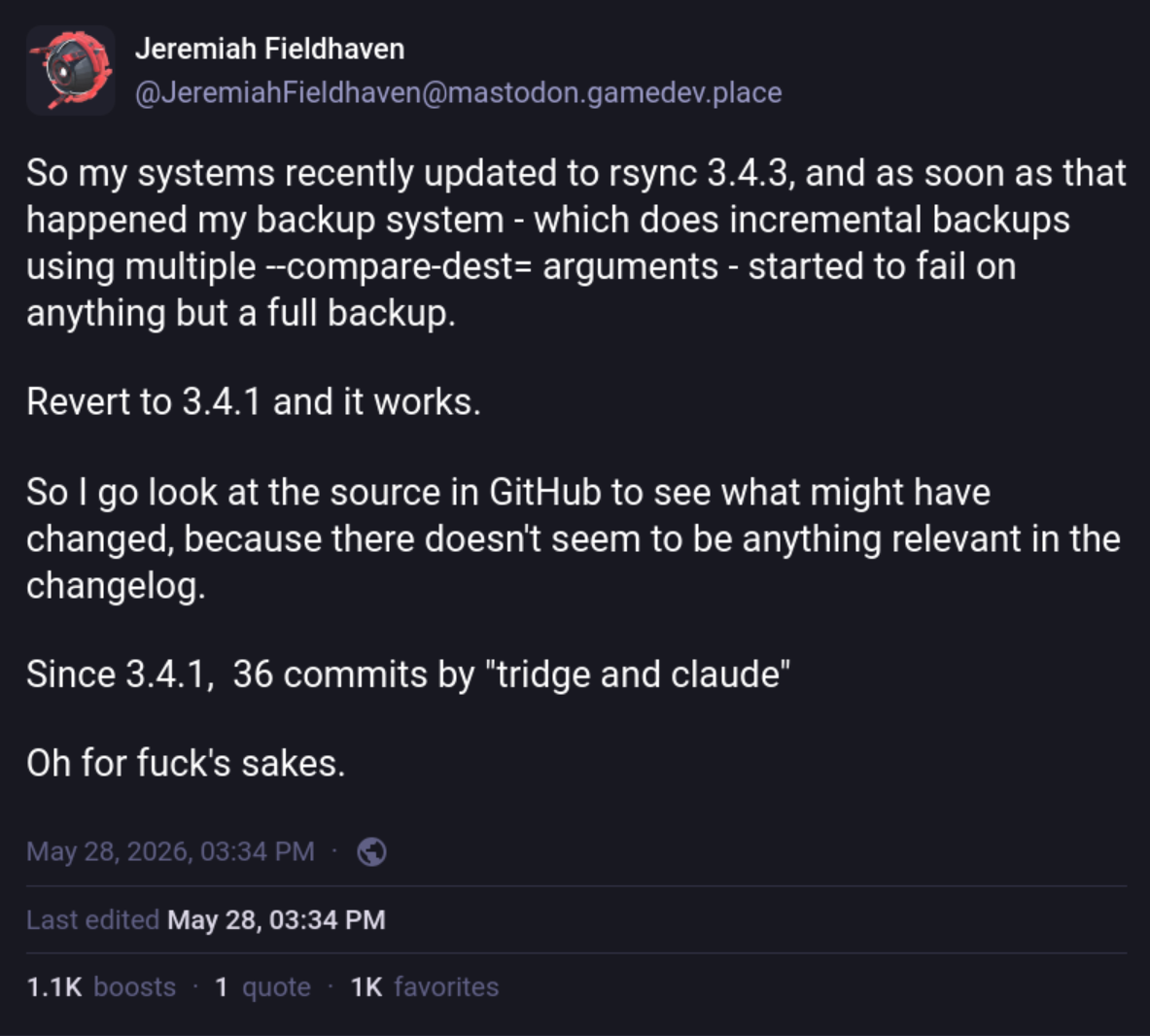
A big point of my comment earlier was that making a project increasingly LLM generated makes it harder for someone to pick up as quickly. A huge amount of complexity can be added insanely fast. In this rsync example, the entire testing system was changed overnight (while generating issues in the process). The projects become harder to work on in general
EDIT: also to add, this still has the issues of not knowing where the un-copyleftable code lies and/or having to rework large portions of the project are if you want to keep that