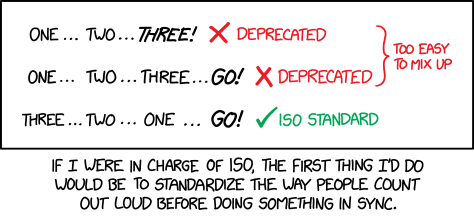
xkcd #3232: Countdown Standard
Title text:
Anyone who is caught counting ‘three … two … one … zero … GO!’ will be punished with a lifetime of eating only ISO standard food samples.
Transcript:
Transcript will show once it’s been added to explainxkcd.com
Source: https://xkcd.com/3232/
You must log in or # to comment.
This, and standardizing what “this Thursday” and “next Thursday” mean. These terms have become functionally useless (to me) because of how they’re used differently by different people. Whenever someone uses these terms to try to intimate a particular date to me, I just ask for the exact calendar date rather than the day of the week to avoid ambiguity.
Edit: I’ve realized this definition was wrong and sleep-deprived and that the actual definition I use is: “This” refers to within this 7-day period of Su–Sa, “Last” refers to the last 7-day period, and “Next” refers to the next 7-day period. I was depriving myself of sleep to finish some work and came up with this. So “this” remains the same, but I just made up some definition of “next” that’s inconsistent with how I’d describe months in years. Hopefully the work is okay.
- “This Thursday” is for the Thursday contained within the Sunday–Saturday interval you’re currently in.
- “Next Thursday” means, starting from 00:00 on a given Thursday, the first Thursday you hit (not including the one you’re on if applicable) as you go forward in time from that point.
- They aren’t mutually exclusive.
Is this not universal? It seems so obvious.
- If it’s a Friday, “this Thursday” is the one from a day ago, and “next Thursday” is six days from now.
- If it’s a Tuesday, “this Thursday” and “next Thursday” are both two days from now.
- If it’s a Thursday, then “this Thursday” is today (albeit weird), and “next Thursday” is seven days from now.
- And “Thursday next week” if it’s Tuesday is the Thursday nine days from now
So if it’s a Friday, “This Thursday” was yesterday? How does that make sense?
“This Thursday” is always the upcoming Thursday.
Last Thursday was fucking yesterday.
There is a rule but it’s not really well known so people just follow whatever rule they deduced from usage. People have to qualify which one they mean almost every time. I usually say “this coming Thursday” (this week), or “Thursday next week” instead.
The rule makes perfect sense (and is how I’ve always used it), but this article actually misses a major point which I just learned last week when talking to some native Spanish speakers. In most English speaking countries, the week starts on Sunday. This isn’t the case for many, many other countries though. So saying “this Friday” on a Sunday really really confuses people. That’s exactly what happened to me last week because it was a Sunday and we were talking about a Friday and she got very very confused.
The day of the week shouldn’t matter, it’s either the Sunday that is coming up next or the one exactly a week after it. “This Sunday” should be the upcoming one and “Next Sunday” should be the one after. Doesn’t matter if it’s this week, next week or in two weeks.
Apollo 11 voice goes ‘4, 3, 2, 1, 0, liftoff’.
Liftoff is a non-integral byproduct of the countdown, not an actual canon part of the sequence.
If you don’t say liftoff then the rockets don’t ignite.
You ignite the rocket before liftoff though?
Right, but if you don’t say it, they won’t have ignited.
It’s similar to the reason rain dances work. They don’t stop dancing until it rains.