

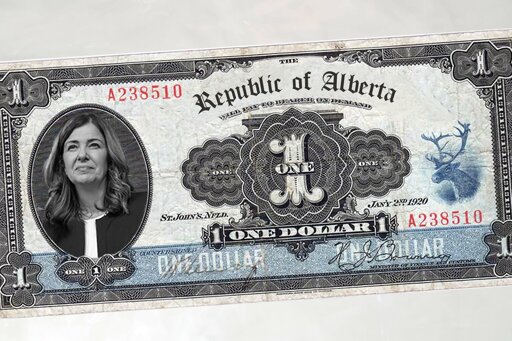
The motivations that have contributed to the separatist movement and Alberta’s sense of grievance in recent years are not especially discrete; it’s more like a nebulous Venn diagram. Simple politics have pushed some people toward separatism. Indeed, the paucity of separatist talk during the time when Stephen Harper was prime minister suggests there’s a significant political component to the idea; when Liberals are in power, people feel more inclined to talk about leaving. Culture also plays a role. When Angus Reid pollsters talked to separatists in February 2026, 86.5 percent said they thought Canada forced Alberta to take in too many immigrants, and 96 percent believed that an independent Alberta would better protect personal freedoms.
But … separatists tend to find the economic arguments particularly seductive. Angus Reid polling shows 96 percent of respondents who want an independent Alberta believe they would be free from economically damaging federal government policies. Separatist leaders promise the elimination of the personal income tax while creating a new provincial sales tax of 5 percent. They also claim Alberta would save $75 billion from no longer paying federal taxes.
Not all separatists promise immediate prosperity, but the argument remains persuasive. Cameron Davies is the leader of the Republican Party of Alberta. “I don’t paint an immediate rosy, utopian picture of what independence looks like,” he says. “Will it be difficult? Yes. Will it be immediate sunshine and rainbows? Probably not. But will it be worth it? Five, ten, fifteen years down the road for your kids and your grandkids? One hundred percent yes.”
The intended purpose of equalization payments is to ensure every Canadian gets a comparable level of government services regardless of where they live. The ‘have’ provinces contribute money to the ‘have-not’ provinces.
Quebec has a big economy, but also a large population. They receive equalization payments because they have a smaller per capita GDP than Alberta, roughly speaking. I’m not current on the exact formula that’s used for equalization payments. The money goes into Quebec’s coffers. Quebec makes budget decisions based on their balance sheet, including funding tuition subsidies and social proprams. Payments don’t end up in one place or another, it’s income that’s used like all other government income.
The fact that Alberta raises more money per capita than the national average and makes equalization payments means they should have a roughly equal ability to fund tuition subsidies or social programs for its population. The reason this doesn’t happen is down to the budget decisions of the Alberta government.
Alberta received equalization payments for a long time, until the 1960s I believe. Depending on what the future holds, they may receive them again in the future. Especially if they don’t diversify from the oil and gas industry. The point of the equalization system is to share Canda’s wealth in an equitable way. Being against it is sort of like someone who complains about their taxes going to healthcare because they don’t go to the hospital. It’s short sighted and selfish.
I don’t have any data at hand, but I know there is a substantial number of Canadians from outside Alberta that have gone there over the years to work in their industries and make the Alberta economy what it is. Why shouldn’t some of that wealth be shared with the rest of Canada that provided that part of the work force?
Finally, I agree that Quebec can be difficult to work with and acts selfishly at times; putting their own interests above those of the rest of the country. However, I think this is a completely separate matter than the topic of equalization payments.
Edit: typo
Receiving federal money coming from Alberta should be tied to allowing Alberta have access to global markets. In my opinion, if Quebec blocks pipelines that should make them unable to collect equalization money. Either they are for a united ‘all for all’ Canada, or they are not.