I really think we should rethink what “defense spending” means. You know, buying these strategic weapons like fancy-ass planes and submarines strike me as an enormous waste of money except insofar as they let us assist/participate in foreign wars (generally wars of aggression by our imperialist neighbor). Any foreign power that would or could meaningfully endanger Canada would utterly overrun anything we could field in terms of “conventional warfare.” If we care about defense, we could be spending instead on light infantry and drones. Hell, just with some back-of-the-napkin math, I suspect we could cut our military budget in half, buy everyone a rifle, and still have a quarter of our military budget left to do things like run trainings for would-be defensive volunteer forces. And I don’t just mean shooting. Like…the military could run first aid classes, outdoor survival courses, computer programming, etc. We could pay people to attend and recieve certification…like for-pay boy scout merit badges or something! We could make ourselves the most unappealing target for invasion without spending very much money at all, and skill-up our people at the same time. We could use “defense spending” to make life better here at home at the same time. Instead we’ll buy honkin big guns we can’t do anything with except tag along with the USA.
Those are the two big items the media focuses on, but there’s the better part of a hundred bidding processes going on IIRC, and more that are awaiting delivery. For example, relevant to the asymmetric scenario, there’s a bunch of MANPADS coming from Sweden.
If you didn’t know, there is a civilian defence force coming online. Also, the land army is splitting into three parts. One for homeland defence, one for foreign defence like our base in Latvia, and one that does support tasks.
(And obviously attack submarines are more about defending our waters)
That’s interesting! I’m sure you know a lot more about it than me. And look, no pressure to respond, I’m saying a lot of shit here, but I really don’t get it.
I’m not invovled, I know very little about it…but am I wrong in thinking that every dollar that’s spent on anything other than asymmetric warfare is not actually defensive in any meaningful sense? Why isn’t the part of the army focused on homeland defense the only part? Or nearly the only part, I know we gotta participate in collective self-defense…but we shouldn’t be spending very much of our defense budget on assets that are only for that purpose…I assume we’re spending a lot more than half on that? If the other parts are paid for with Canadian taxpayer money, it’s fair to ask how those other parts make life for Canadians better. And maybe there’s a really good clear explanation for it, but I haven’t seen it. It might just be “the US expects it of us and we have to do what they want,” but if so, we should be constantly thinking about why and whether we can afford to roll it back. And I’m not saying we shouldn’t be in Latvia or whatever. Us being there deters Russian aggression and that’s a good thing. But I think if we’re gonna increase our military budgets, it doesn’t have to be on military hardware that’s primarily useful in us fighting other people’s wars.
Just going off your example with the submarines…what does “defending our waters” mean in this context? Defending against what from whom? If we had no military whatsoever, and the only challenge was getting enough boots on canadian soil, how many world powers could actually field an invasion of Canada? Russia, China, the USA, maybe India…anyone else? Would any of them have any trouble dealing with whatever “conventional warfare” defenses we can muster? Maybe that’s what I misunderstand, are these weapons that significant?
Maybe I’m wrong and these submarines or MANPADS or planes could actually make a difference in a conflict, idk. But dollar for dollar, i can’t imagine it does better than a larger number of armed and trained light infantry among the populace. Especially given all we’re learning about cheap drones from Ukraine and Iran.
Again, what do I know…I’m just saying from a lay person’s perspective, talking about this kind of spending looks like we’re focused on participating in conflict elsewhere. I’d be happy to hear otherwise. But I don’t like to see my town’s library closing on weekends for budgetary reasons while we spend 75 billion on fighter planes that we’re just going to use to help the US kill people who are not able or interested in attacking us. We shouldn’t have been in afghanistan or the gulf war.
I’m not involved, I know very little about it…but am I wrong in thinking that every dollar that’s spent on anything other than asymmetric warfare is not actually defensive in any meaningful sense?
Just going off your example with the submarines…what does “defending our waters” mean in this context?
Maybe I’m wrong and these submarines or MANPADS or planes could actually make a difference in a conflict
There’s a spectrum of what weapons can do. MANPADS (so that’s shoulder mounted anti-aircraft missiles, basically) are almost a pure guerilla weapon. Easy to hide and transport, last literally decades like we found out with the Taliban, and very dangerous for someone taking off in, for example, an expensive F-35. A diesel attack sub will need maintenance eventually, but it’s hard to find and can operate independently for weeks, maybe longer if you have some kind of covert resupply.
The German ones in particular are almost undetectable. It’s designed to wait on the seafloor where a major enemy target like an aircraft carrier might come through, and then sink it in an ambush. Will that stop them in their tracks? No, but the Americans are very afraid of losing an entire supercarrier, and it’s happened in wargames. Hanwha’s offering is less superlative at that, but can also operate for longer and deliver ballistic missiles, which is interesting if we wanted to do a sneaky strike at something on land.
The Gripen is an attempt to make a fighter than can function out of the backcountry maintained by conscripts, so it’s middle-of-the-road or unconventional-leaning as well. The F-35 needs an actual airbase to operate out of, so it’s pretty purely conventional, but it’s just absolutely cheat-tier in the wargames. The air force really wants them, because it’s like having an invisible player in the rink. If we end up fighting Russia instead they’ll be invaluable.
But dollar for dollar, i can’t imagine it does better than a larger number of armed and trained light infantry among the populace.
Without any air defence, for example, the Americans can basically be overhead at all times, monitoring us and taking pot shots when they feel like it. They love operating that way, especially when it’s an unpopular war and every dead American soldier is a major media event. They’re doing it in Iran right now, for example. If we can shoot aircraft down some of the time, they have to be careful how they operate them, and the playing field gets a lot more even.
It has to be emphasised that the financial end isn’t about cost per unit so much as cost exchange. A million dollar single shot is completely worth it if it brings down something worth a billion. Similarly, a relatively cheap $10,000 interceptor still can’t be used on a $1000 drone. And, usually a mix of tools has a synergy and works better (“combined arms”), which is why we have one.
There’s also the objectives and limitations of each party to the conflict. The Americans can afford to lose a carrier group, but they also don’t care about Canada that much. If we were invadeable by fishing boat like Greenland they’d be a lot more tempted; if they’re facing a major if single-sided war right on their border they can probably still be deterred.
And I’m not saying we shouldn’t be in Latvia or whatever. Us being there deters Russian aggression and that’s a good thing.
Why isn’t the part of the army focused on homeland defense the only part?
That NATO and the US alliance is dead isn’t something all politicians are resigned to yet, and even if it is (c’mon it absolutely is), we still have allies. And that support goes both ways; if they were to actually come to our aid against the US in full force, a conventional victory would be on the table. Failing that, being a guerilla is a lot easier with foreign support.
Maybe I’m wrong and these submarines or MANPADS or planes could actually make a difference in a conflict, idk. But dollar for dollar, i can’t imagine it does better than a larger number of armed and trained light infantry among the populace. Especially given all we’re learning about cheap drones from Ukraine and Iran.
Okay, well if you care to say more, I’m interested. I’ve never heard of a country getting invaded by a vastly larger and better armed military and doing well except by asymmetric means, but like I said, I don’t claim to be an expert. Like, I don’t think a handful of tanks or planes in the hands of the Finnish or Vietnamese would have mattered, but maybe there’s a better analogue!
I didn’t say don’t fight asymmetrically I am saying don’t be convinced drones make traditional military power obsolete, you still need ships, artillery, armored vehicles etc…
A US attack was war gamed by CAF back in January and the conclusion was that Canada’s defense would have to be asymmetric because we wouldn’t have a chance at anything else.


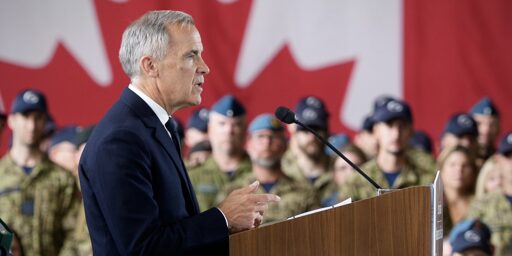
I really think we should rethink what “defense spending” means. You know, buying these strategic weapons like fancy-ass planes and submarines strike me as an enormous waste of money except insofar as they let us assist/participate in foreign wars (generally wars of aggression by our imperialist neighbor). Any foreign power that would or could meaningfully endanger Canada would utterly overrun anything we could field in terms of “conventional warfare.” If we care about defense, we could be spending instead on light infantry and drones. Hell, just with some back-of-the-napkin math, I suspect we could cut our military budget in half, buy everyone a rifle, and still have a quarter of our military budget left to do things like run trainings for would-be defensive volunteer forces. And I don’t just mean shooting. Like…the military could run first aid classes, outdoor survival courses, computer programming, etc. We could pay people to attend and recieve certification…like for-pay boy scout merit badges or something! We could make ourselves the most unappealing target for invasion without spending very much money at all, and skill-up our people at the same time. We could use “defense spending” to make life better here at home at the same time. Instead we’ll buy honkin big guns we can’t do anything with except tag along with the USA.
Those are the two big items the media focuses on, but there’s the better part of a hundred bidding processes going on IIRC, and more that are awaiting delivery. For example, relevant to the asymmetric scenario, there’s a bunch of MANPADS coming from Sweden.
If you didn’t know, there is a civilian defence force coming online. Also, the land army is splitting into three parts. One for homeland defence, one for foreign defence like our base in Latvia, and one that does support tasks.
(And obviously attack submarines are more about defending our waters)
That’s interesting! I’m sure you know a lot more about it than me. And look, no pressure to respond, I’m saying a lot of shit here, but I really don’t get it.
I’m not invovled, I know very little about it…but am I wrong in thinking that every dollar that’s spent on anything other than asymmetric warfare is not actually defensive in any meaningful sense? Why isn’t the part of the army focused on homeland defense the only part? Or nearly the only part, I know we gotta participate in collective self-defense…but we shouldn’t be spending very much of our defense budget on assets that are only for that purpose…I assume we’re spending a lot more than half on that? If the other parts are paid for with Canadian taxpayer money, it’s fair to ask how those other parts make life for Canadians better. And maybe there’s a really good clear explanation for it, but I haven’t seen it. It might just be “the US expects it of us and we have to do what they want,” but if so, we should be constantly thinking about why and whether we can afford to roll it back. And I’m not saying we shouldn’t be in Latvia or whatever. Us being there deters Russian aggression and that’s a good thing. But I think if we’re gonna increase our military budgets, it doesn’t have to be on military hardware that’s primarily useful in us fighting other people’s wars.
Just going off your example with the submarines…what does “defending our waters” mean in this context? Defending against what from whom? If we had no military whatsoever, and the only challenge was getting enough boots on canadian soil, how many world powers could actually field an invasion of Canada? Russia, China, the USA, maybe India…anyone else? Would any of them have any trouble dealing with whatever “conventional warfare” defenses we can muster? Maybe that’s what I misunderstand, are these weapons that significant?
Maybe I’m wrong and these submarines or MANPADS or planes could actually make a difference in a conflict, idk. But dollar for dollar, i can’t imagine it does better than a larger number of armed and trained light infantry among the populace. Especially given all we’re learning about cheap drones from Ukraine and Iran.
Again, what do I know…I’m just saying from a lay person’s perspective, talking about this kind of spending looks like we’re focused on participating in conflict elsewhere. I’d be happy to hear otherwise. But I don’t like to see my town’s library closing on weekends for budgetary reasons while we spend 75 billion on fighter planes that we’re just going to use to help the US kill people who are not able or interested in attacking us. We shouldn’t have been in afghanistan or the gulf war.
There’s a spectrum of what weapons can do. MANPADS (so that’s shoulder mounted anti-aircraft missiles, basically) are almost a pure guerilla weapon. Easy to hide and transport, last literally decades like we found out with the Taliban, and very dangerous for someone taking off in, for example, an expensive F-35. A diesel attack sub will need maintenance eventually, but it’s hard to find and can operate independently for weeks, maybe longer if you have some kind of covert resupply.
The German ones in particular are almost undetectable. It’s designed to wait on the seafloor where a major enemy target like an aircraft carrier might come through, and then sink it in an ambush. Will that stop them in their tracks? No, but the Americans are very afraid of losing an entire supercarrier, and it’s happened in wargames. Hanwha’s offering is less superlative at that, but can also operate for longer and deliver ballistic missiles, which is interesting if we wanted to do a sneaky strike at something on land.
The Gripen is an attempt to make a fighter than can function out of the backcountry maintained by conscripts, so it’s middle-of-the-road or unconventional-leaning as well. The F-35 needs an actual airbase to operate out of, so it’s pretty purely conventional, but it’s just absolutely cheat-tier in the wargames. The air force really wants them, because it’s like having an invisible player in the rink. If we end up fighting Russia instead they’ll be invaluable.
Without any air defence, for example, the Americans can basically be overhead at all times, monitoring us and taking pot shots when they feel like it. They love operating that way, especially when it’s an unpopular war and every dead American soldier is a major media event. They’re doing it in Iran right now, for example. If we can shoot aircraft down some of the time, they have to be careful how they operate them, and the playing field gets a lot more even.
It has to be emphasised that the financial end isn’t about cost per unit so much as cost exchange. A million dollar single shot is completely worth it if it brings down something worth a billion. Similarly, a relatively cheap $10,000 interceptor still can’t be used on a $1000 drone. And, usually a mix of tools has a synergy and works better (“combined arms”), which is why we have one.
There’s also the objectives and limitations of each party to the conflict. The Americans can afford to lose a carrier group, but they also don’t care about Canada that much. If we were invadeable by fishing boat like Greenland they’d be a lot more tempted; if they’re facing a major if single-sided war right on their border they can probably still be deterred.
That NATO and the US alliance is dead isn’t something all politicians are resigned to yet, and even if it is (c’mon it absolutely is), we still have allies. And that support goes both ways; if they were to actually come to our aid against the US in full force, a conventional victory would be on the table. Failing that, being a guerilla is a lot easier with foreign support.
You are very wrong about this.
Okay, well if you care to say more, I’m interested. I’ve never heard of a country getting invaded by a vastly larger and better armed military and doing well except by asymmetric means, but like I said, I don’t claim to be an expert. Like, I don’t think a handful of tanks or planes in the hands of the Finnish or Vietnamese would have mattered, but maybe there’s a better analogue!
I didn’t say don’t fight asymmetrically I am saying don’t be convinced drones make traditional military power obsolete, you still need ships, artillery, armored vehicles etc…
A US attack was war gamed by CAF back in January and the conclusion was that Canada’s defense would have to be asymmetric because we wouldn’t have a chance at anything else.