Hairy ball theorem applies to even-dimensional spheres (the ordinary sphere is the 2D surface of the 3D solid), but a cube in four-dimensional space is a three-dimensional surface, so it doesn’t apply.
This is a question about graph theory, not topology; it’s asking for a Hamiltonian path on the surface of 4D cube (where faces are vertices, which is different than the normal polytope graph).
However most proofs of the hairy ball theorem also prove the converse, so that there is a continous non vanishing tangent vector field on uneven dimensional sphere surfaces.
This can be extended to all 3 dimensional surfaces in 4 dimensions homomorphic to the sphere. The ant walking can follow the vector field and solve this problem topologically.
My point being that the HR goon following the expected leet code solution might not understand this because they might expect the “approved” graph theory solution rather than an alternative approach.
Why does following a tangent vector field visit all faces of the hypercube? Surely it’s not going to visit something like a dense subset of the hypersphere’s surface? (Or is it? My intuition comes from thinking about the torus)
My topology and maths are very rusty, am a software developer these days.
I think that there are both tangent vector fields that don’t and some that do. In the two dimnsional case (circle) certainly all do.
In n I intuitively would say that you should be able to have a vector field that does but I am now less confident to think about a proof on my bus rides while I answer here. I tried twice already.
I will try to think about this more, will ping here if I get more


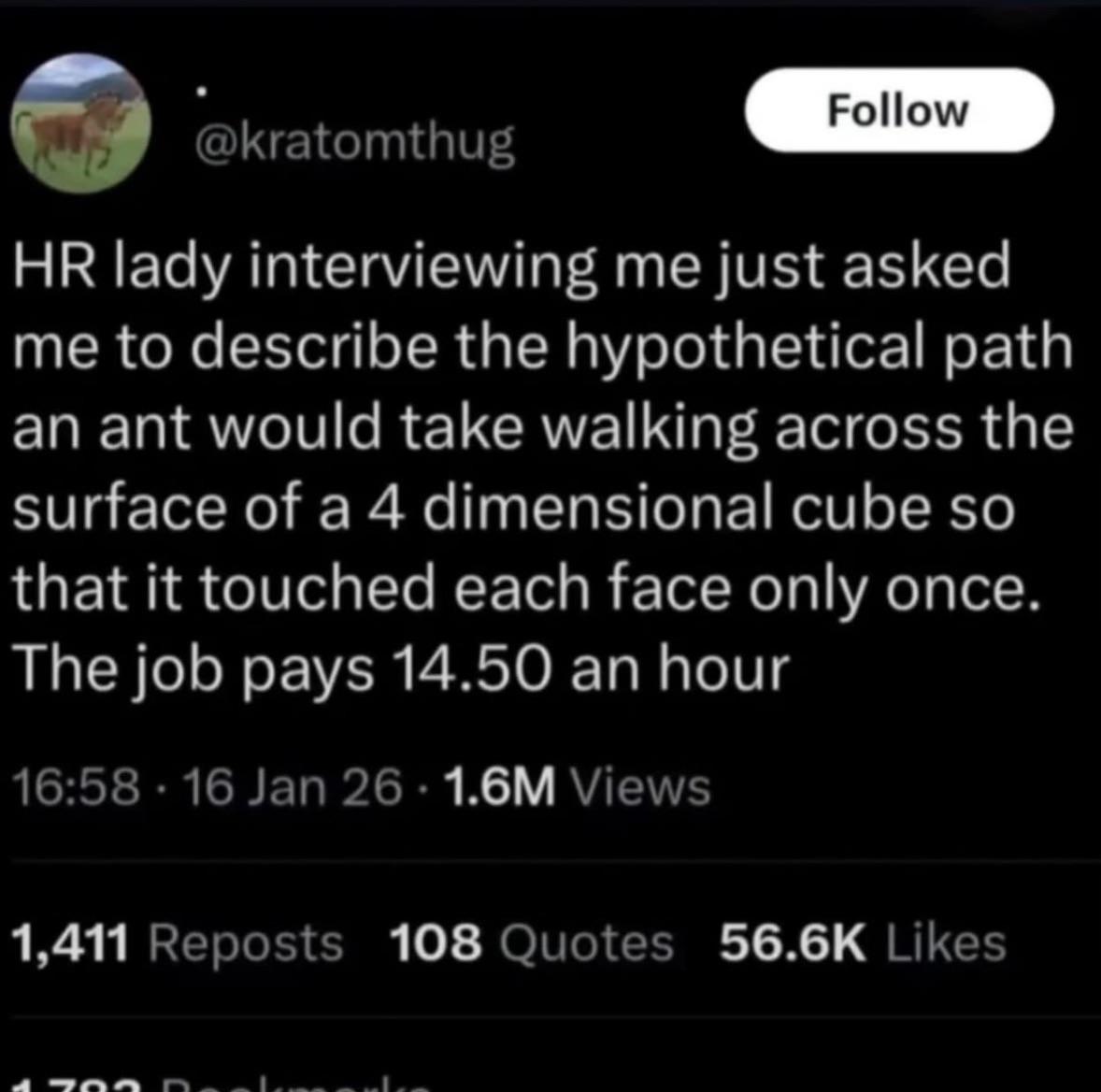
This is a direct appliacation of the hairy ball theorem.
I ain’t even kidding
https://en.wikipedia.org/wiki/Hairy_ball_theorem
Hairy ball theorem applies to even-dimensional spheres (the ordinary sphere is the 2D surface of the 3D solid), but a cube in four-dimensional space is a three-dimensional surface, so it doesn’t apply.
This is a question about graph theory, not topology; it’s asking for a Hamiltonian path on the surface of 4D cube (where faces are vertices, which is different than the normal polytope graph).
You are right.
However most proofs of the hairy ball theorem also prove the converse, so that there is a continous non vanishing tangent vector field on uneven dimensional sphere surfaces.
This can be extended to all 3 dimensional surfaces in 4 dimensions homomorphic to the sphere. The ant walking can follow the vector field and solve this problem topologically.
My point being that the HR goon following the expected leet code solution might not understand this because they might expect the “approved” graph theory solution rather than an alternative approach.
Why does following a tangent vector field visit all faces of the hypercube? Surely it’s not going to visit something like a dense subset of the hypersphere’s surface? (Or is it? My intuition comes from thinking about the torus)
I’m more interested in the maths ;)
My topology and maths are very rusty, am a software developer these days.
I think that there are both tangent vector fields that don’t and some that do. In the two dimnsional case (circle) certainly all do.
In n I intuitively would say that you should be able to have a vector field that does but I am now less confident to think about a proof on my bus rides while I answer here. I tried twice already.
I will try to think about this more, will ping here if I get more
You’re hired 🤝
Yaayyy, where’s my hypercubicle?