

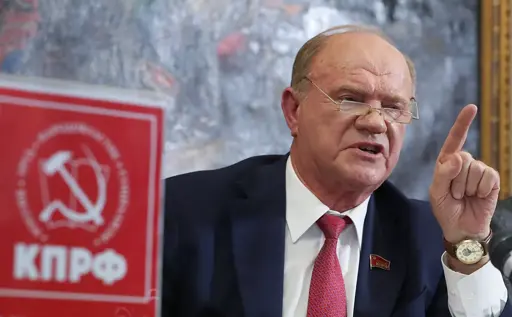
According to him, the country’s economy “hit rock bottom” in the first quarter, which could lead to a crisis.
Zyuganov also suggested that the situation this fall could resemble the events of 1917, when the communists came to power.
Video with English subtitles available here: https://bsky.app/profile/antongerashchenko.bsky.social/post/3mk3d7tu6m22v
I would be interested in the example in Korea in particular, I had never heard of this.
There isn’t a lot of readily available info on as it was crushed by 2 repressive regimes, and the CCP isn’t exactly welcoming to historians interested in a freer society within their borders that “socialists” and the Japanese empire both worked to crush.
https://en.wikipedia.org/wiki/Korean_People's_Association_in_Manchuria?wprov=sfla1
This is quite interesting, and since there’s so little information available we can only speculate as to why the Korean Communists assassinated their leadership.
I’m afraid this does reinforce my point that Anarchist experiments tend to only arise locally in chaotic situations - in this case manchuria during the Chinese warlord era - and then get crushed. In wartime, Marxist-Leninist centralization and discipline tends to make for more resiliency, hence the Chinese and Korean communists surviving the war and going on to take power.
Do you think Korean communist took power?
Do you think they still have power (despite writing communism out of their constitution)?
I don’t think the success of a Korean warlord that paid lip service to communism in order to get aid from the communist block, was much of a victory for the working class.
And while Mao was more genuine in his attempt to build a socialist socialist, I don’t think modern day china with it’s ban on unions is in any way more socialist than any other capitalist nation, especially not ones where workers enjoy secotral bargaining.
Neither Korea or China are perfect, but they both survived. Was Kim Il Sung a real ideological communist or just an opportunist? He’s dead, so we can’t ask him, but living standards in the North were higher than in the South under his rule, there was free healthcare. Private capital still seems to have little power in North Korea, and the power of capital is curtailed in China as well. Whether or not they can be called socialist is up for debate, but they’re certainly closer to socialism than any Western democracies.
As far as democracy goes, we’ll take China as an example. You wouldn’t call them a democracy, but they’re much more responsive to the needs and interests of the people than any western democracy. What’s better, a single-party state that acts in the interests of the people, or a democratic state that completely ignores them?
How is a state where workers can’t organize more socialist than one where workers can?
Lol, there is no public healthcare, no free childcare, you have to pay to go to high school, no unions, I don’t see how you can claim they are more responsive to people’s needs than states that y-know respond to people’s needs?