

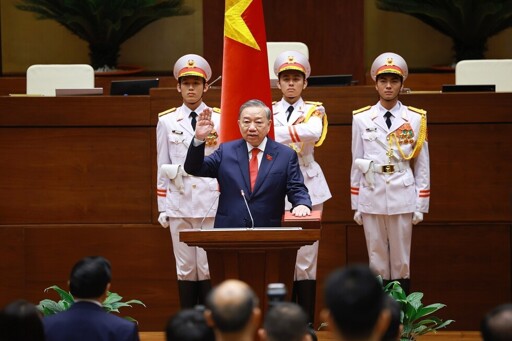
Vietnam unanimously elected Communist Party General Secretary To Lam as president for a five-year term, consolidating his control over both the party and the state.
The move departs from Vietnam’s tradition of shared leadership, in which the jobs have typically been held by different people, and echoes power structures in China under Xi Jinping and neighboring Laos.
It has been widely expected since Lam’s reelection as Communist Party head in January, when observers noted that his consolidation of party authority positioned him to assume the presidency as well.
also why are you bringing up the noted cia agent?
To be clear, this isn’t even a controversial take btw. No human being, much less someone educated holds these beliefs:
On the Islamic World
Liu broadly supported U.S. militarism.[38]: 77 He supported U.S. President George W. Bush’s 2001 invasion of Afghanistan, his 2003 invasion of Iraq and subsequent reelection.[47][48][49][50] Liu supported other U.S. interventions in the Middle East as well,[38]: 77 alongside the Vietnam and Korean War.[49]
In his 2004 article titled “Victory to the Anglo-American Freedom Alliance”, he praised the U.S.-led post-Cold War conflicts as “best examples of how war should be conducted in a modern civilization.” He wrote:
He also wrongly predicted that “a free, democratic and peaceful Iraq will emerge.”[51]
He commented on Islamism that, “a culture and (religious) system that has produced this kind of threat (Islamic fundamentalism) must be inherently intolerant and bloodthirsty.” He also criticized the Iraq prison abuse scandals.[52] During the 2004 US presidential election, Liu again praised Bush for his war effort against Iraq and condemned Democratic Party candidate John Kerry for not sufficiently supporting the wars in which the U.S. was then involved.[51][53]
On Israel, he said “without America’s protection, the long persecuted Jews who faced extermination during World War II, would probably be drowned once more by the Islamic world’s hatred.” He had defended U.S. policies in the Israeli–Palestinian conflict, which he thought was effective in mediating between the two sides.